Eight directions, one centre you keep.
Before it was an amulet, the bagua was a way of describing position — which side of a situation you are on, and which way is out. The mirror version came later, and it came from doors.
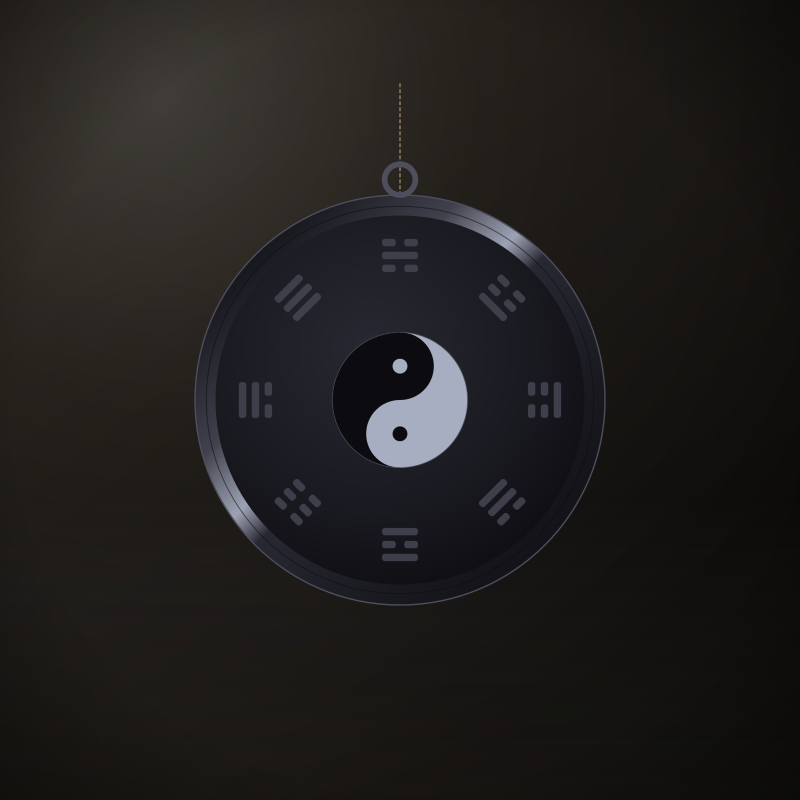
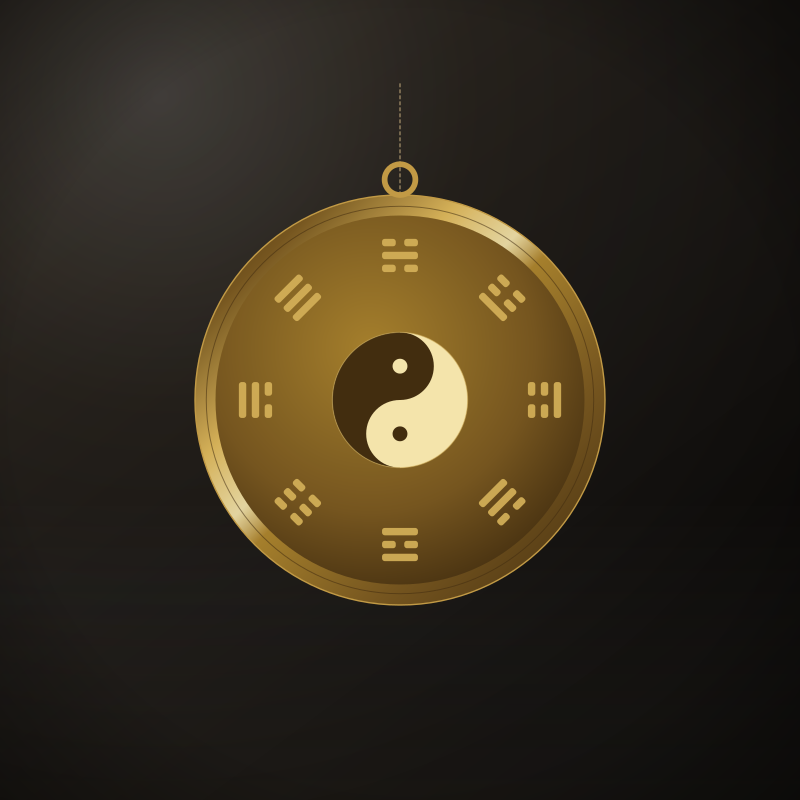
- 1Eight sectorsOne for each direction, with the seasons in order — the King Wen arrangement.
- 2A circle with no topThe rim is continuous, so the diagram can be read from whichever side you are standing on.
- 3The centreNot one of the eight. It is the position you read them from.
Who this shape is for.
- You moved this year and have not settled which corner the desk belongs in.
- You keep being described as “in between things” and would like a picture of that.
- You want an object that is legible from across a room, not a private mark.
Pieces in this form
2 pieces in this form
Free worldwide shipping over $99 · 1-Year Fortune Guarantee · Consecrated before it ships
Where the shape comes from
The eight trigrams are older than the book that explains them. They appear in the received Zhouyi as stacked lines — three per trigram, broken or unbroken — and their invention is credited to Fu Xi, a culture hero whose historicity nobody can establish. What can be established is that numerical trigram marks were scratched onto Zhou bronzes and Han tomb objects, which is to say people were carrying them before anyone wrote a commentary. Two arrangements survive: the Earlier Heaven sequence and the King Wen sequence. Amulets almost always use the second, because it maps onto compass directions that a house actually has.
A bagua is a circle divided into eight, with something still at the middle. That geometry is doing the work. Each sector is a direction, a season, a family member, a quality of movement — the same eight words reappearing in different registers. The centre is not one of the eight; it is the position from which you can see all of them. It is also why the object is round rather than square: a map with a fixed top tells you which way to face, a map with no top tells you where you are. The trigram lines are cut rather than printed, so they catch light at an angle and disappear when the piece turns flat against you.
The mirror form — a polished disc with the eight trigrams around the rim, hung above a door — is a later and much more specific object, and it is a defensive one. It faces outward, at the entrance, on the theory that a threshold is where a household is most exposed. We do not make the mirror. A concave mirror over a door in a rented flat raises a question the landlord will ask, and the piece stops being worn, which is the only thing that makes it work as an object you own. The flat pendant keeps the information and loses the confrontation.
You can wear a bagua because it is a good diagram. Eight sectors, one centre, no top — that is a more honest map of a situation than most of what gets drawn on whiteboards. That reading asks nothing of you and promises nothing back. The other reading is available too: that a threshold matters, that a room has a direction it prefers, that some positions are better than others. We are not going to argue you out of it. We are only going to say the piece is well made either way, and that we make no claim it will change what happens to you.
Asked and answered
Earlier Heaven or Later Heaven?
The pendants use the King Wen arrangement, because it corresponds to compass directions and to the seasons in order. The Earlier Heaven sequence is a different diagram — it is about opposition rather than position — and we do not use it on a wearable, where the point is to read your own situation at a glance.
Should the centre be a taiji?
On most amulets it is, and on ours it is too: the yin-yang disc sits inside the eight. Historically the two diagrams travelled separately and were combined later. If you want the taiji on its own, that is a different piece in this collection and a different argument.
Can I hang it over a door?
You can hang it, but a pendant makes a poor mirror — it is small, it is not polished to reflect, and it was not designed for that purpose. If what you want is the door tradition, tell us and we will say when we make one.
Where to go next
Meanings it serves
Other forms
The collection