Two forces, one circle, no winner.
The taiji is the most reproduced diagram in the world and the least accurately dated. What it says survives the muddle: nothing stays at its peak, and the turn is already inside the peak.
- 1A curve, not a diameterNeither half can be at its widest while the other is — that is the whole claim.
- 2ClosedIt comes back. The shape says the process repeats; it does not say the repeat is welcome.
- 3The dotThe opposite is already inside. A taiji without the two dots has lost the argument.
Who this shape is for.
- Something just went very well and you are waiting for the bill.
- You are in the middle of a bad stretch and want the reminder that it is a stretch.
- You distrust symbols that only work in one direction.
Pieces in this form
2 pieces in this form
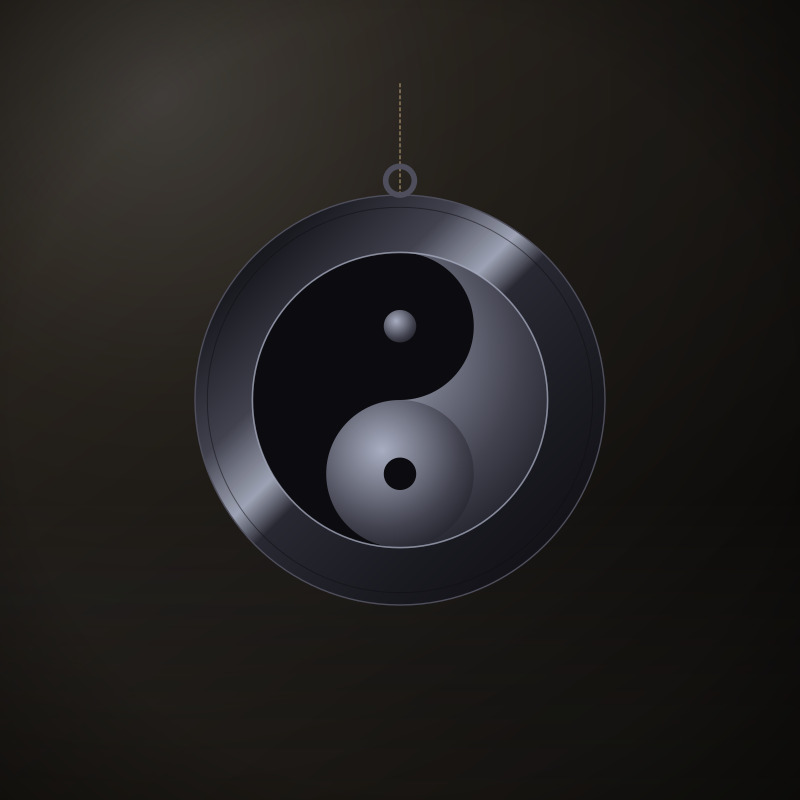
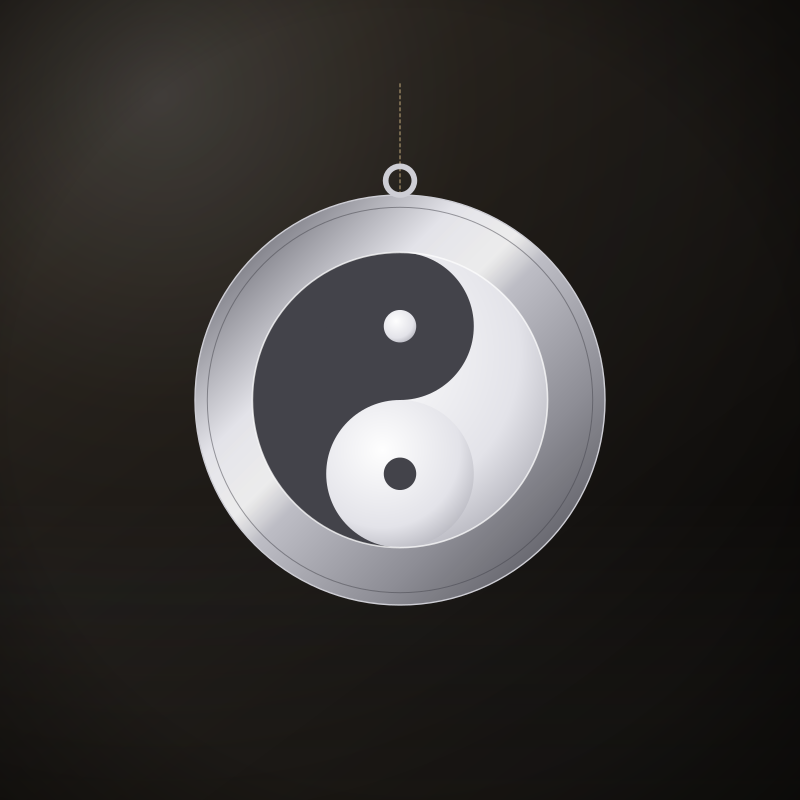
Free worldwide shipping over $99 · 1-Year Fortune Guarantee · Consecrated before it ships
Where the shape comes from
The words first, then the picture. 太極 appears in the Xici commentary as the source from which the two modes arise — a term in a cosmology, not a logo. The diagram as you know it, two fish-shaped halves with a dot of the opposite colour in each eye, cannot be traced to the classical period. The Song scholar Zhou Dunyi wrote an explanation of the taiji in the eleventh century, but his diagram was a stack of circles, not a swirl. The fish form appears in Ming-era diagrams, with a version credited to Lai Zhide. Between the word and the picture there is a gap of roughly two thousand years, and almost every commercial object in the world ignores it.
The shape is an argument made without words. A circle, because the process is closed — it comes back. A division that is a curve rather than a diameter, because the boundary is never where an outside observer would put it. Each half widens as the other narrows, so neither can be at maximum at the same time. The dots are the part people skip: at the widest point of white there is black already inside it. That is the whole claim, and it is not a comforting one. It says your good year is carrying the seed of the bad one, and the reverse — which is the only version of the idea that is useful while things are going well.
Ours are cut in obsidian and cast in silver. Obsidian is volcanic glass: no grain, no crystal structure, so it takes an edge and reflects like a dark mirror. The practical consequence is that the two halves cannot be shown by colour, because the whole material is nearly black. We cut one half lower than the other and polish only the raised side, so the division reads as a change in sheen as you move. Silver does the opposite: both halves are engraved and oxidised, and the contrast appears in the order you touch it.
The taiji is the easiest piece here to own without believing anything, because it is also a diagram of a system with feedback — growth that slows as it reaches a limit, then reverses. Anyone who has run anything has watched that happen. If you want the cosmological reading, it is there and it is old. If you want a symbol for the fact that this is a peak and peaks turn, that is a complete reason to wear it. We make no claim that wearing it will move the turn.
Asked and answered
Which half is yin?
The dark, receptive, descending half, traditionally. On obsidian both halves are dark, so we mark yin as the recessed face rather than the darker one — colour cannot carry the distinction here, depth can.
Is this the same as the I Ching?
It is a summary, not a source. The Zhouyi is sixty-four hexagrams built from the same kinds of lines. The taiji is the picture people draw when they do not want to explain the book.
What do the two dots mean?
That the opposite is already present. A design without them has drawn two halves of a circle, not a taiji, and the argument is gone.
Where to go next
Meanings it serves
Other forms
The collection