A circle you close with your own hand.
Beads came to China with a religion and stayed as an object. The wrist version is recent, the counting is not — and the counting is the part that does something.
- 1One bead, one countA single bead is a stone. A string of them is a timer, and the timer is the useful part.
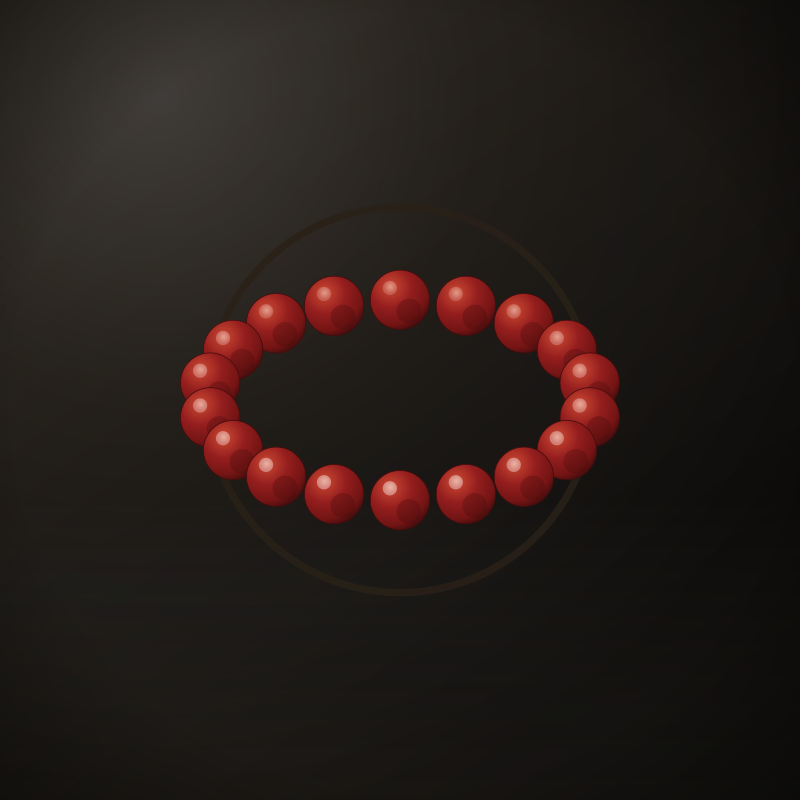
- 2Eighteen to twenty-twoWhat fits a wrist. A full 108 is a hand strand — the wrist version is a modern proportion.
- 3The knotThe only element that gives when the strand is pulled. It fails first, so a break costs one bead.
Who this shape is for.
- You already count things — steps, breaths, days without a cigarette.
- You want red and are tired of red that looks like plastic.
- You are buying for someone whose faith you do not share and want to be respectful about it.
Pieces in this form
1 piece in this form
Free worldwide shipping over $99 · 1-Year Fortune Guarantee · Consecrated before it ships
Where the shape comes from
Strung beads arrived along the Silk Road with Buddhism, and the number that matters is 108 — the count of afflictions in that tradition, and the reason a full mala is that long. A wrist strand is a shortening, and the shortening is late. In the Qing court a hand-held strand of eighteen beads, 十八子, hung from a robe button rather than sitting on the wrist, and it was a status object as much as a devotional one. Cinnabar is older still: mercury sulfide, ground as pigment for seals and ink, listed in the materia medica. The red you see on a bead is not the mineral's natural colour so much as its most useful property.
A single bead is a stone. A string of them is a timer. The point of a mala is not the material but the repetition — you move one bead per recitation, and the string keeps count so your attention does not have to. That is a technology, and it is why the object survives in cultures with no interest in the doctrine behind it. The knot matters as much as the beads: it is the only element that gives when the strand is pulled, and it is the part that fails first. Ours are knotted between beads rather than strung straight through, so a break costs one bead instead of the whole strand.
Be honest about the material. Historic cinnabar is mercury sulfide, which is toxic: nobody should chew it and it should not be heated. The beads sold today, including ours, are cinnabar powder bound in resin and sealed — stable in normal wear, and not the same material as the mineral. Keep it away from children and do not wear it into a hot bath. It is also soft, around two to two and a half on the Mohs scale, so it marks before it breaks, and a bead that has been marked is a bead that has been worn. We would rather tell you this than sell you a red stone and let you find out.
Most people who buy this wear it as a colour. Red against skin, matte rather than glossy, no clasp to fail. That is a complete reason. If you want the counting, learn one short line and use the strand as a counter; the object will do its job the first evening. What it will not do is change your circumstances, and the 108 afflictions are not a list we can verify.
Asked and answered
108 beads or 18?
For a wrist, eighteen to twenty-two depending on the stone — that is what fits an average wrist. A full 108 is a hand strand, worn around the neck or looped twice. If you want the traditional count, buy the hand strand; the wrist version is a modern proportion and we do not pretend otherwise.
Left wrist or right?
Tradition puts devotional strands on the left. In practice, the hand you do not write with. Consistency beats side.
Will the red fade?
Sealed cinnabar holds its colour. It will dull where it rubs against a desk, and that dulling is permanent. Keep it out of hot water and off abrasive surfaces.