A face that looks outward so you can look away.
The animal mask is the oldest design in this collection and the one whose name is most disputed. Modern archaeology stopped calling it a taotie, and the reason is worth a paragraph.
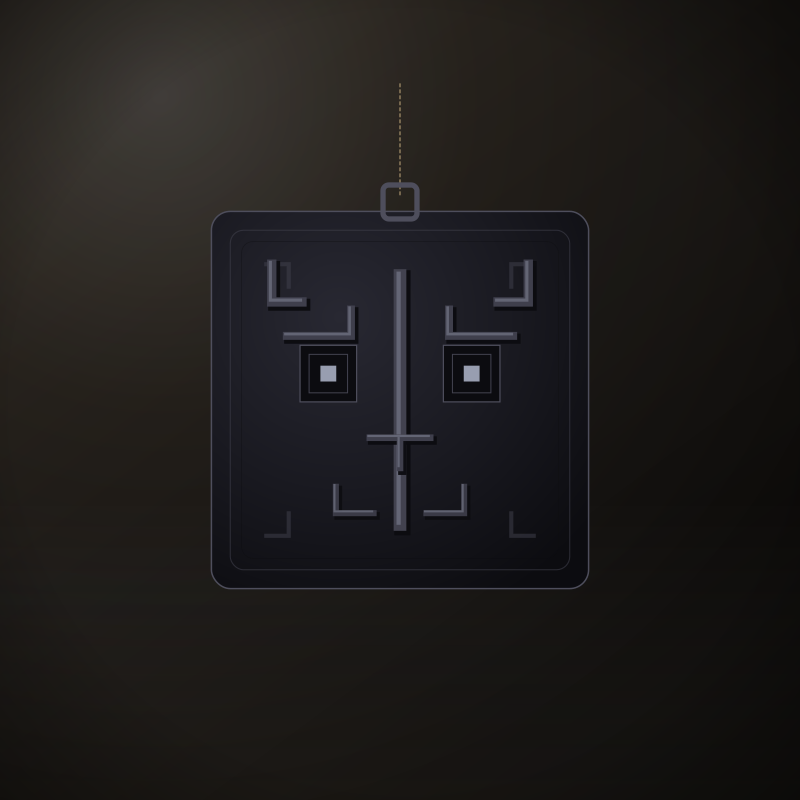
- 1Squared eye, stepped browAngles read as pattern. A round eye with a curved brow reads as a face, and a face is a worse charm.
- 2A jaw that does not closeThe mask on a Shang vessel is never a whole animal. The gap is the design, not the damage.
- 3The flangeTwo lines down the centre, not one. One line reads as a crack; two read as a spine.
Who this shape is for.
- You want something that faces out, not something that soothes.
- You like objects that are difficult rather than decorative.
- You have a specific room or person in mind and would rather not explain.
Pieces in this form
1 piece in this form
Free worldwide shipping over $99 · 1-Year Fortune Guarantee · Consecrated before it ships
Where the shape comes from
The animal mask appears on Shang bronzes from around 1300 BC: symmetrical, front-facing, with a divided body and eyes that dominate the composition. For centuries it was called 饕餮, the insatiable glutton of the Lüshi Chunqiu — a text written roughly a thousand years after the bronzes were cast. Twentieth-century scholarship noticed the gap and the absence of any inscription naming the motif, and adopted the neutral term 獸面紋, animal-mask pattern. That is the current usage. So the object you are looking at is older than its name by a millennium, and the name describes a moral nobody at the time wrote down.
The mask works because it is front-facing. Almost every other motif on a Shang vessel runs in profile; the mask turns to meet you, which is why it was placed on the most visible face of the vessel and later on door knockers, 鋪首, where it also served as a handle. The features are cut in angular strokes rather than curves: squared eyes, a stepped brow, a vertical flange down the centre. That angularity is not a stylistic preference. Rounded forms with paired circular eyes read as a face — an expression, a character. Angular forms read as a pattern. A charm should be a pattern; a face on your chest is a different and much worse object.
The first two versions of this piece were failures and both failed the same way. A round medallion with two round eyes and curved brows renders as a cartoon mask, and no amount of added detail fixes it, because the problem is the reading, not the resolution. The version we make is a square plaque, square eyes, all folded strokes, a raised centre flange, and relief built in three offset layers — shadow, body, highlight — with two pixels of displacement. Any more and the lines separate. Obsidian supplies the shadow half of that sandwich for free.
This is the piece people buy for a door, a desk, or a person they would rather not think about. The tradition it comes from is apotropaic — the mask faces outward so that whatever is coming sees it first — and that is a legible idea whether or not you accept the metaphysics. What we will not do is sell it as protection against a named threat. It is a heavy object with a face on it, made in a material that shows every fingerprint, and it asks to be worn rather than displayed. That is the whole of the claim.
Asked and answered
Is it a taotie?
Probably not, and nobody can say. The name comes from a text a thousand years younger than the motif, and no bronze of the period labels it. We use the archaeological term on the card and mention the older name because people search for it.
Is a beast charm aggressive?
It is apotropaic, which is a different thing — the face is turned outward, not toward you. On a door knocker it is a handle. Worn, it is the same idea at smaller scale.
Why obsidian for this one?
Because the design depends on shadow. The relief is read by the dark side of each fold, and a glossy black stone supplies that contrast without any applied finish. Cut in brass, the same carving reads as ornament rather than as a face.