A ring with nothing in the middle to catch on.
The peace disc is a modern object with an ancient ancestor, and the distance between them is worth knowing before you buy one.
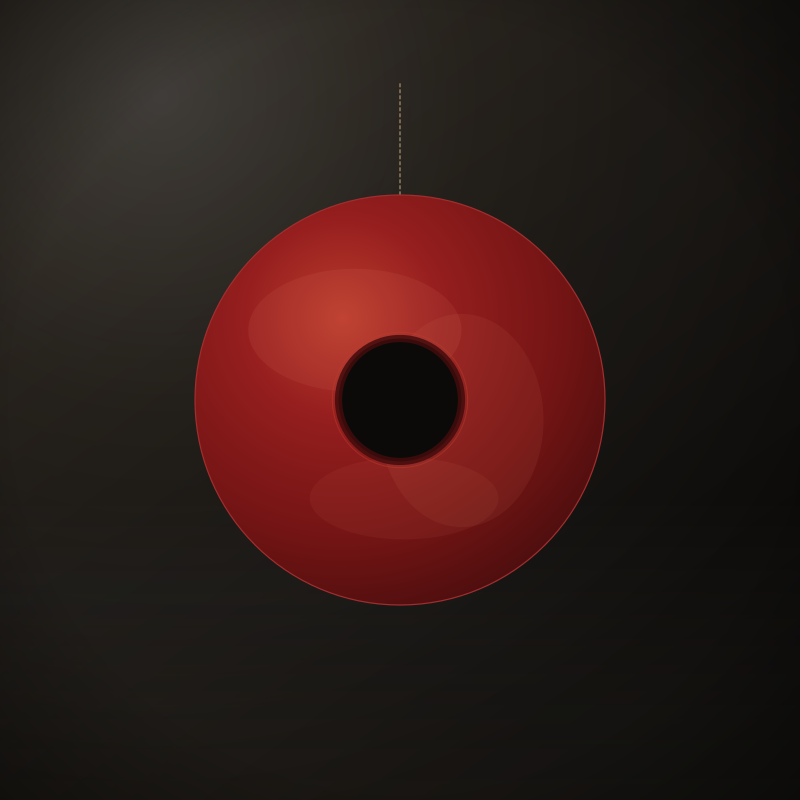
- 1Ring width, twice the holeThe Erya's definition of a bi. We keep the proportion at pendant size, not the ritual.
- 2The boreDrilled from both sides and finished by hand — which is why it is slightly waisted in the middle.
- 3No settingNothing holds the stone. There is no clasp to fail and no centre to dent.
Who this shape is for.
- You want one object you can wear every day and stop thinking about.
- You are buying a first piece of jade and would rather not be sold a story.
- You want to give something to a person whose taste you cannot predict.
Pieces in this form
2 pieces in this form

Free worldwide shipping over $99 · 1-Year Fortune Guarantee · Consecrated before it ships
Where the shape comes from
Jade discs with a central hole — 璧 — are among the oldest surviving Chinese jades, produced in the Liangzhu culture from roughly 3300 BC and standardised through the Shang and Zhou. The Erya, a dictionary of the third century BC, defines the proportions: when the width of the ring is twice the diameter of the hole, it is a bi. These were ritual and burial objects, some large enough to need two hands, and they were not worn on a cord by ordinary people. The small convex disc sold today as a 平安扣 is a modern object that borrows the geometry and none of the ritual.
A disc with a hole is the plainest possible form that still has a boundary. No clasp, no setting, no stone to come loose. The hole is the point: it is where the cord goes, so the object hangs without hardware, and it also means there is no centre to dent. Compare it with a cabochon in a bezel, which is a stone held by something else — the disc is a stone that holds itself. In nephrite, that simplicity is also a structural argument: a thick ring resists the hairline fractures that kill thinner jade forms, which is why this shape survives two thousand years of burial while more elaborate carvings do not.
The material matters more than the shape. Nephrite is the older jade of China: an amphibole, tough rather than hard, carved by abrasion with sand and water because it will not take a chisel. It is soft enough to wear against skin for decades and to hold body warmth for a while after you take it off, which is the closest a stone gets to being tended. Jadeite — the brighter, glassier stone most people picture — arrived in quantity only in the eighteenth century. Ours is nephrite, untreated, with the colour variation left in. A perfectly even piece of jade at this price is either dyed or not jade.
You can buy this because a green-white ring is one of the few objects that looks correct with everything, in every decade, and because it will outlive the fashion that made you want it. You can also buy it because a disc with a hole in it is the shape of a bowl seen from above, and bowls are for holding. Neither reading requires belief. We do not claim the stone will protect you; we do claim it will not crack, because we will replace it if it does.
Asked and answered
Is a peace disc the same as a bi?
A descendant in shape, not in function. A bi was a ritual object with defined proportions, often buried. A peace disc is a small worn pendant. We use the Erya proportions where they make sense at this size, and we say so rather than implying a continuity that is not there.
Will it change colour?
Nephrite takes on oils from skin and darkens slightly over years. It can also be re-polished, which is why old jade often looks newer than its age. Dye and polymer treatment are the things to avoid; ours has neither.
Is the hole drilled or carved?
Drilled from both sides and finished by hand, which is why the bore is slightly waisted in the middle on some pieces — the historical method leaves that mark, and we do not polish it out.